
UEH Announces Its 2025–2030 Strategy, with a Vision to 2045: Co-Creating Value for a Sustainable Future
21 Nov, 2026


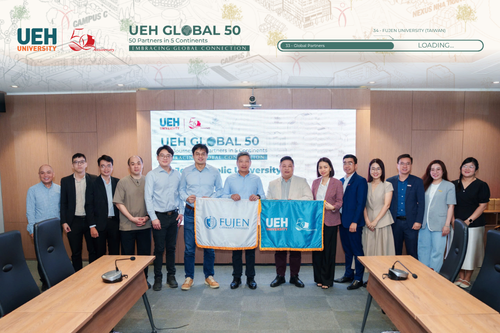
Key moment UEH50: A Journey of Knowledge - People - Future
Co-creating value for a sustainable future
Fifty years of growth and development have given the University of Economics Ho Chi Minh City (UEH) a solid foundation of knowledge, people and academic reputation. UEH is a source of high-quality human resources with more than 280,000 alumni and a diverse academic ecosystem of nearly 40,000 undergraduate and postgraduate learners. Nearly 60% of its faculty are professors, associate professors or PhD holders, supported by international experts, visiting lecturers and industry practitioners across its 4 member colleges: the College of Business, the College of Economics, Law and Government, the College of Technology and Design, and the Talent College, as well as 2 branch campuses: UEH Mekong in Vinh Long Province and UEH Nexus Nha Trang in Khanh Hoa Province.
Over this half-century journey, the support of businesses, partners and the community has brought education and research closer to real-world needs and widened opportunities to apply and share knowledge. Each contribution reflects a bond nurtured throughout the University’s development.
The strategy poses a key question for the new phase: With whom will UEH co-create new value for the future? UEH recognizes that today’s universities can no longer simply follow development or confine knowledge to lecture halls and laboratories. A university must become a place that prepares people for the future and connects knowledge with real-world challenges.

UEH announces its Strategy for 2025-2030, with a vision to 2045, toward the model of a Value Co-creation University and an Urban and Regional Innovation Hub
The strategy places collaboration among stakeholders at the heart of value creation. Economic development, quality of life, technological innovation and environmental protection all require the participation of many parties whose knowledge, experience and resources complement one another.
Co-creation requires all parties to take part in identifying problems and in designing and testing solutions. This approach keeps education and research closely aligned with societal needs, while enabling academic outcomes to be applied and to deliver value in practice.

UEH aims to become a Value Co-creation University and an Urban and Regional Innovation Hub
Entering the 2025–2030 period, with a vision to 2045, UEH has set out a strategic shift: moving from a traditional university model to the model of a “Value Co-creation University” and gradually becoming an Urban and Regional Innovation Hub built on five strategic pillars:
First, educating global citizens with multidisciplinary and interdisciplinary thinking, a capacity for practical action and a commitment to sustainability.
Second, conducting scientific research tied to contemporary challenges and to the problems facing localities and the nation.
Third, developing a green campus that serves as a Living Lab, a Field Lab and a Sandbox for controlled experimentation, connecting multiple stakeholders: the State, the University, Businesses, the Community and the Natural Environment.
Fourth, practicing digital, data-driven governance that places people and sustainability at its center.
Fifth, connecting stakeholders to co-create: jointly identifying problems, jointly mobilizing resources, jointly developing solutions and sharing value for the common good.
Five dimensions of co-creation
The strategy puts collaboration into practice through five dimensions, linked to education, research, talent development, innovation and resource contribution.
Co-Education - Co-creation in education. UEH encourages partners to take part in educational activities, linking learning with real-world demands. Learners gain access to multidisciplinary knowledge, develop problem-solving skills and better understand their professional responsibility to society.
Co-Research & Knowledge Transfer - Joint research and knowledge transfer. The University works with partners to identify research questions, connect expertise and share practical experience. These collaborations aim to produce results with scientific value and practical applications that meet the needs of localities, businesses and communities.
Co-Talent & Career Pathways - Joint talent development and career pathways. Collaboration between the University and employers helps align education with professional requirements, supporting learners as they build their capabilities and shape their future. Talent development is linked to workforce needs and changes in the labor market.
Co-Innovation - Joint innovation. UEH brings together the knowledge, technology and experience of different parties to jointly develop and test solutions. Real-world problems give rise to new initiatives and provide an environment for validating the applicability and value of innovation.
Co-Investing & Giving - Joint investment and resource contribution. The University is broadening the involvement of partners, alumni and the community in developing shared activities. Resources are brought together to support education, research, innovation and initiatives that serve society.
Upholding and promoting the 8 core values of the ONE UEH community: Solidarity - Compassion - Dedication - Pioneering - Responsibility - Internationalization - Innovation - Sustainability, the 2025-2030 strategy, with a vision to 2045, builds on the knowledge foundation and enduring commitment of the UEH community over 50 years of development. In the spirit of “Embracing Future Together”, the University and its partners are advancing collaboration in education, research and innovation, aiming to make concrete contributions to quality of life, local development and a sustainable future.
News, photos: Department of Communications and Partnerships