
UEH Selected to Join the Advanced AI Training Project: Transforming Technology into Socio-Economic Value
20 Nov, 2026


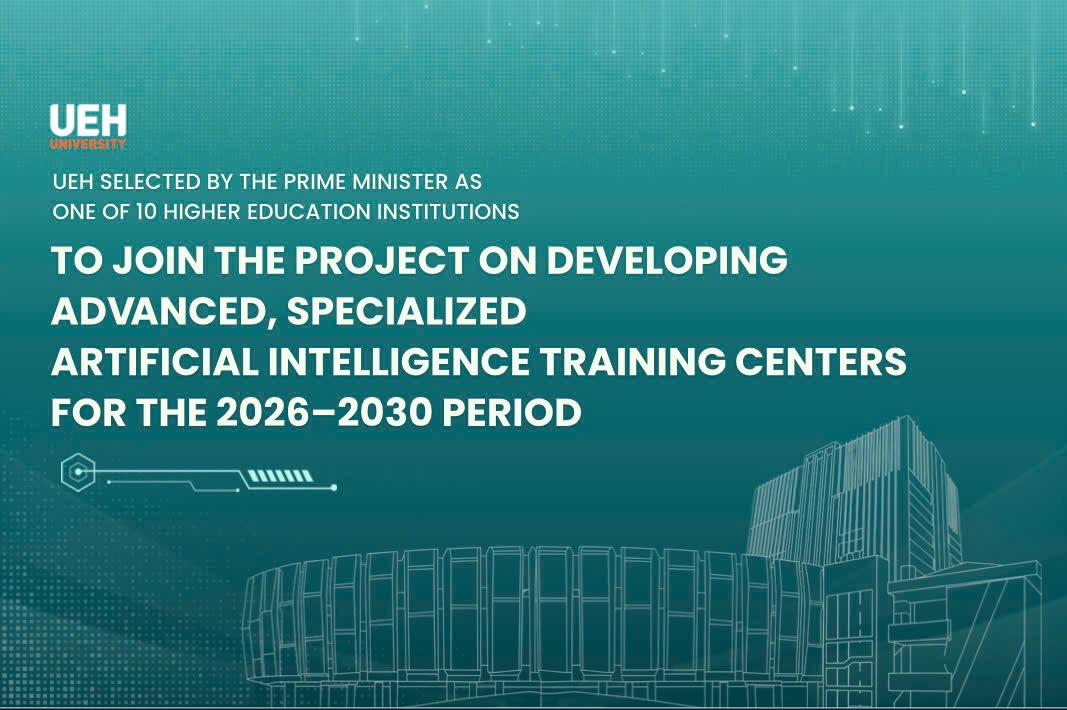
The University of Economics Ho Chi Minh City (UEH) is one of 10 higher education institutions selected for the initial phase of the Project on developing selected training institutions into advanced, specialized centers for artificial intelligence for the 2026–2030 period. With its foundation as a multidisciplinary university, UEH is oriented toward connecting its technological capabilities with knowledge in economics, business, law, governance, and design — transforming AI into productivity, innovation, and value for the community.
On November 8, 2026, Deputy Prime Minister Le Tien Chau signed Decision No. 2146/QD-TTg of the Prime Minister approving the Project on developing selected training institutions into advanced, specialized centers for artificial intelligence for the 2026–2030 period. UEH is named on the list of 10 institutions taking part in the initial phase, contributing to Vietnam's network for the training, research, development, application, and governance of AI.
A multidisciplinary foundation for the role of connecting technology with practice
The national Project is oriented toward developing the centers along a hub-and-network model, with defined roles, linkage, and resource sharing; tying training, research, and technology transfer to the needs of the State, businesses, and society. Within that orientation, UEH has the foundation to contribute through its capacity to connect technology with fields of application.
This capacity is built on its strengths in economics, business, and governance, together with its ongoing development of technology, data, and AI programs. The combination of disciplines, its system of laboratories, innovation spaces, and partner network enables UEH to approach AI challenges across technical, economic-efficiency, implementation-readiness, and social-impact dimensions.
For an AI solution to create value, it must be integrated into an organization's data, operating processes, and decision-making methods. This process requires human resources who both understand the technology and are well-versed in the field of application, with the ability to assess effectiveness and manage risks. This is the space UEH focuses on developing as it joins the network.
Under UEH's AI development project, the University aims to play the role of connecting foundational AI research groups with the challenges of businesses and the public sector. UEH develops its technological capabilities while taking the capacity to apply, govern, and transform AI into socio-economic value as its distinctive focus. Its research directions include the capacity to absorb, integrate, and scale AI applications; and the impact on productivity, employment, skills, and business models.
Training human resources, co-developing and transferring AI solutions
Taking part in the Project, UEH is oriented toward continuing to review its programs, learning outcomes, and AI-integrated content; and toward developing specialized, interdisciplinary, and applied training by field. The focus is on forming two complementary streams of human resources: technology professionals who understand sector-specific challenges, and domain experts capable of exploiting data and applying AI to their work.
Learners need to be equipped with the capacity to identify problems, select methods, implement solutions, and verify results. Alongside specialized knowledge, the requirement of responsible AI use is embedded throughout the training process, tied to data protection, reliability, and accountability.
In research and transfer, UEH proposes a two-way mechanism connecting technology research groups with businesses, localities, and the public sector. The parties jointly take part from framing the problem and preparing data to developing, testing, and evaluating the solution. Real-world needs become inputs for research and training; test results, in turn, are used to refine the technology, assess implementation readiness, and scale up.
Under this approach, the effectiveness of AI is verified through concrete changes such as reduced task-processing time, optimized costs, improved decision quality, higher productivity, or expanded access to services. At the same time, the research process helps clarify the conditions in human resources, organization, and governance needed for the technology to take effect.
This direction is tied to the strategy of becoming a co-creating university in the role of a Nucleus of Urban Innovation – the UEH UniverCity Innovation Hub, connecting knowledge, technology, and partners to jointly solve the challenges of businesses, cities, and regions. Being selected to join the Project creates further conditions for UEH to upgrade its AI training, research, and cooperation foundation, contributing to the national network through high-quality human resources and solutions that generate measurable socio-economic value.
|
Five years of integrating applied AI knowledge into strategy, training, research, and transfer
|
News and photos: Department of Communications and Partnerships