QS Sustainability 2027: UEH Rises 41 Places, Achieving Its Highest Ranking in Four Years of Participation
19 Nov, 2026
Strengthening its position in the global sustainability ranking
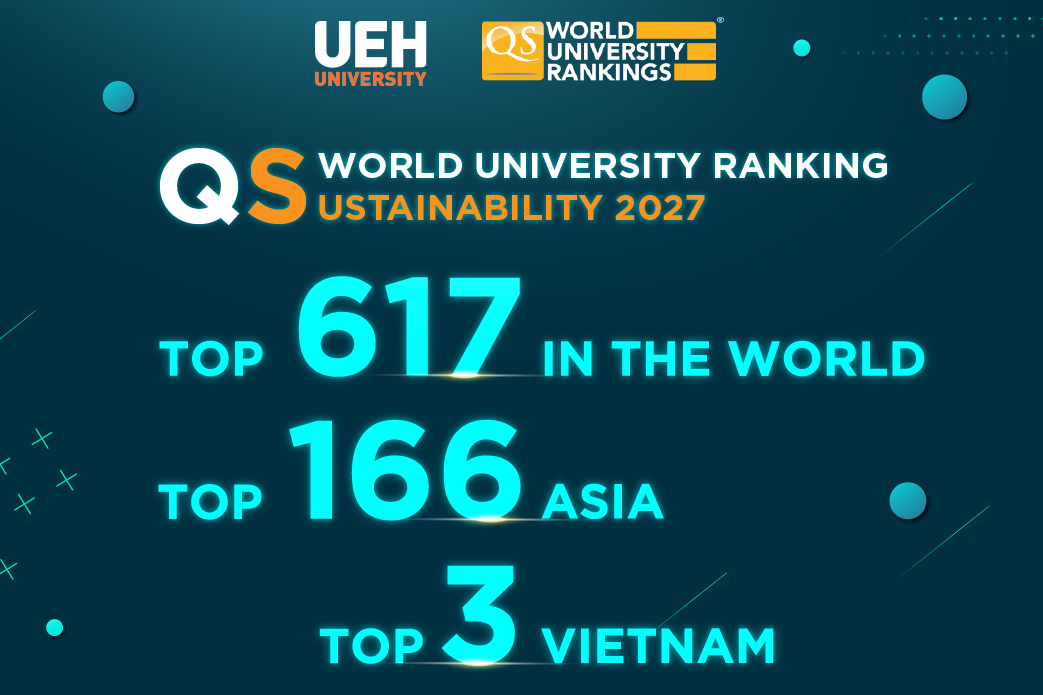
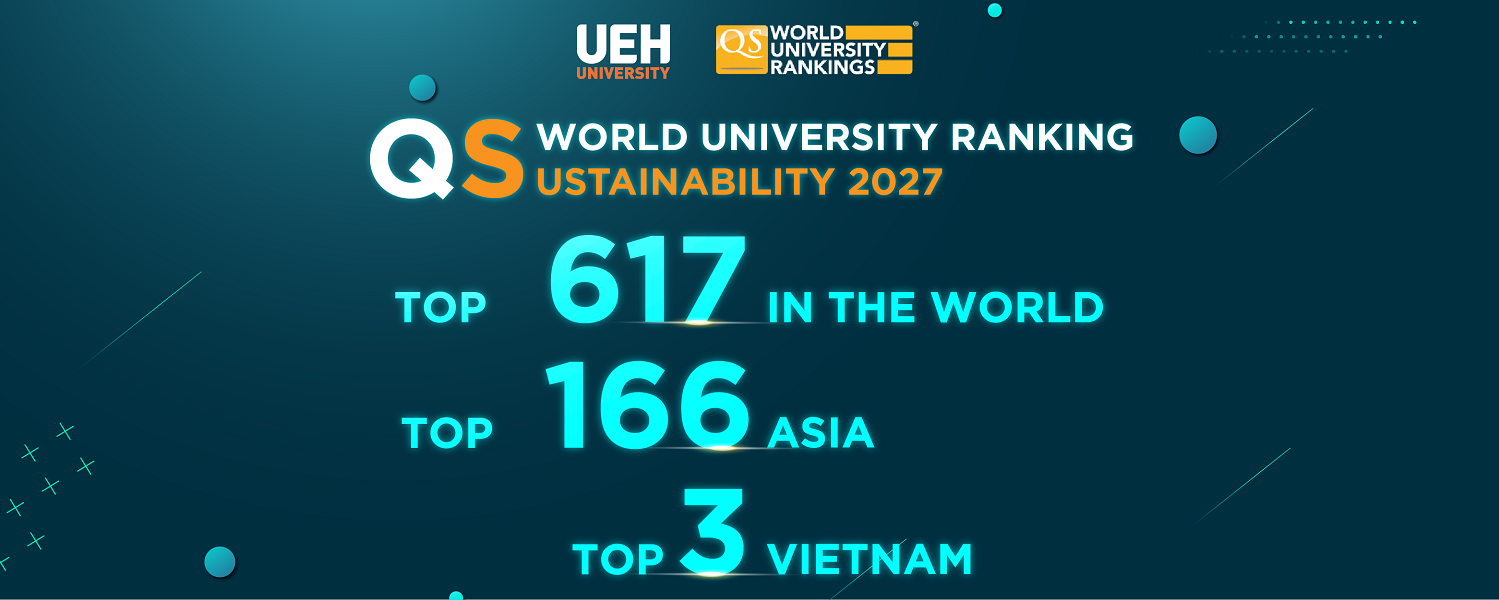
UEH first appeared in the QS Sustainability Rankings in the 2024 edition, placing in the 841–860 band worldwide with a score of 45.4. Over the next two editions, the University ranked 653rd and 658th respectively, while its overall score continued to rise from 55.0 to 63.1. In the 2027 edition, UEH scored 68.1 points and achieved its best ranking across four editions. In Asia, UEH climbed 18 places, from 184th to joint 166th out of 850 ranked institutions. The University also placed 35th in Southeast Asia.
QS assesses universities’ contributions to sustainable development across three categories: Environmental Impact (45%), Social Impact (45%) and Governance (10%). UEH scored 54.4, 77.3 and 88.1 points respectively. Notably, its Social Impact score rose by 5.7 points compared with the previous edition. UEH’s two highest-scoring indicators were Equality at 91.7 points, ranking 4th in Asia and 2nd in Southeast Asia, and Knowledge Exchange at 91.1 points, ranking 58th in Asia. In the Environmental Impact category, Environmental Research scored 85.0 points, up 1.7 points, and ranked 108th in Asia.
Five years of embedding sustainable development across university activities
Since 2021, UEH has built its sustainable university model on five pillars: education, research, governance, operations and community engagement.
In education, UEH has developed the Glo-cal Education model, which aims to nurture global citizens who can take action and create positive impact in their local communities. The University has integrated sustainability content into more than 120 courses, while also developing specialized programs and courses in health economics and management, corporate sustainability and environmental management, smart architecture and urban design, smart and creative urban governance, and innovation and entrepreneurship. The model is interdisciplinary and built on experiential learning, lifelong learning and Living Labs, combined with emerging technologies such as AI, Data and Robotics. Each year, UEH organizes around 120 community education events and 35 short-term training programs, and attracts more than 2,500 learners from outside UEH to its learning activities.
In research, UEH pursues its Research Contribution for All orientation, linking research, education and social impact. From 2020 to 2025, UEH published 2,450 international articles, 87.1% of which appeared in Scopus Q1/Q2 journals, and carried out 498 research projects and 3,878 student research projects. SDG-related research alone has remained above 500 publications per year. Collaborative programs with the World Bank, UN-Habitat, EU Jean Monnet and SEI/EfD address green growth, climate change, sustainable finance and urban development, helping turn academic knowledge into practical solutions for society.
In governance, UEH has embedded sustainable development into its governance system as an overarching strategic priority. The University has established a three-tier governance model spanning strategy, coordination and operations to ensure the SDGs are implemented in a coordinated way. The OKR system is applied to nearly 1,000 managers, lecturers and staff, ensuring that every development goal is quantified, tracked and regularly evaluated.
In operations, through its “From Green to Carbon Neutral” strategy, UEH treats its campus as a living laboratory for learning, research and testing environmental solutions in practice. The UEH Green Campus ecosystem now spans 13 campuses and 3 dormitories, with 58 green initiatives that bring together governance, education and community action. To date, UEH has generated 470,000 kWh of clean solar power, recycled 10 tonnes of waste and reduced more than 1.27 million units of CO₂ emissions. Through its innovation programs, Green Campus and more than 100 environmental events, UEH has drawn more than 100,000 participants to education and action for sustainable development.
In community engagement, UEH has built an ecosystem that connects the University with businesses, government, international organizations, alumni and the community to co-create impact. The UEH network now comprises 280,000 alumni, 1,593 partner businesses and 119 international organizations. The University has mobilized more than VND 300 billion in scholarships and VND 70 billion in corporate sponsorship, creates around 6,000 job opportunities each year and has supported more than 100 student start-up projects.
* See UEH’s Sustainability Report on the 17 SDGs here.
From campus to city and region under the 5 CO orientation
In the 2026-2030 period, UEH is implementing the Co-creating University – Urban Innovation Hub Strategy (UniverCity Innovation Hub), which extends collaboration from the university campus to the city and the region. Through this model, UEH aims to work with government, businesses and communities to identify local priorities, connect experts and develop solutions suited to each locality.
The 5 CO orientation sets out how UEH and its partners take part in this process:
- Co-Education expands learning opportunities by co-creating programs and learning experiences.
- Co-Research & Knowledge Transfer connects research teams with the needs of businesses and localities to conduct joint research and transfer knowledge.
- Co-Talent & Career Pathways links education with talent development and career pathways.
- Co-Innovation brings UEH and its partners together to develop and test solutions to real-world problems.
- Co-Investing & Giving mobilizes resources to expand educational opportunities and support community initiatives.
The QS Sustainability Rankings 2027 results give UEH further grounds to benchmark progress on its strategy and set priorities for the next phase. Building on its strengths in equality and knowledge exchange, UEH will continue to widen access to education while placing greater emphasis on environmental education and sustainable practices in its operations. These are areas in which learners, staff and partners can take part directly, helping bring to life the message “UEH Acting Together for Our Shared Future”.
News, photos: Department of Research - Development and Global Engagement; Department of Communications and Partnerships