VNUR 2026: UEH Maintains Top 4 Position, Affirming Training Quality Linked to the Labor Market
23 Jan, 2026


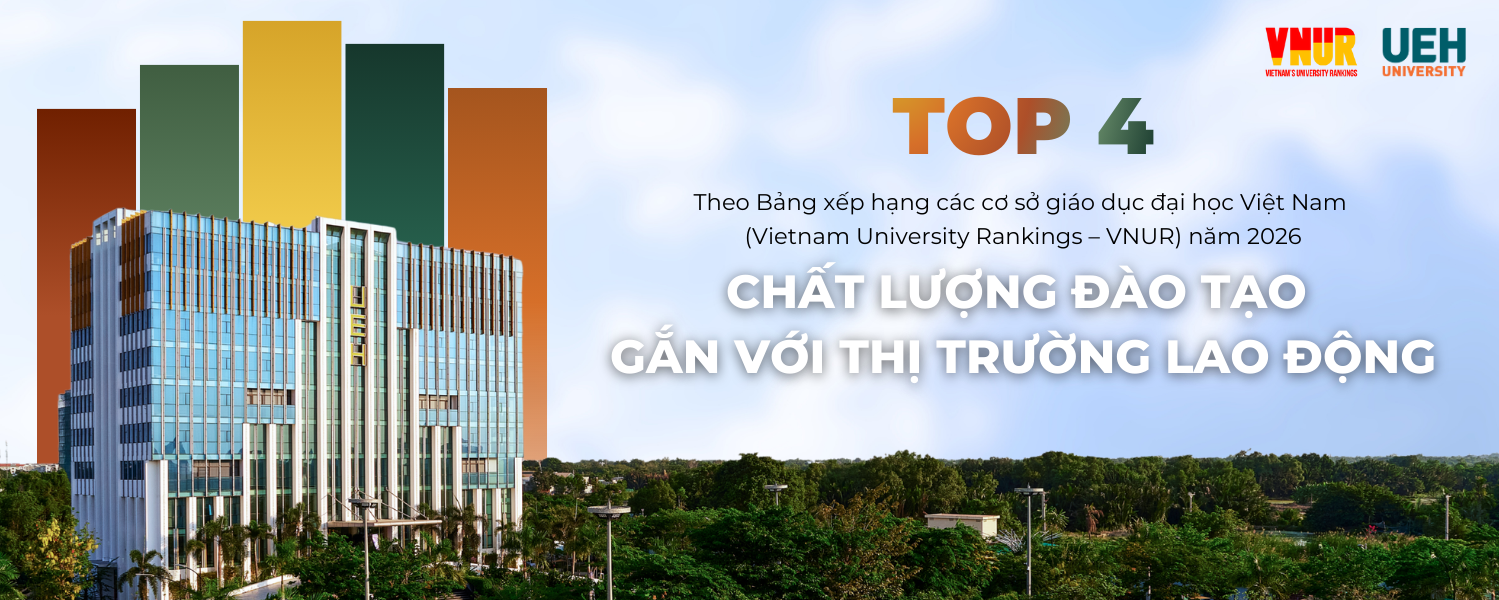
The 2026 Vietnam's University Rankings (VNUR) have been officially announced, showing shifts in the rankings of 93 out of 100 higher education institutions and highlighting the growing competitive pressure and demand for quality enhancement within Vietnam's higher education system. In this context, the University of Economics Ho Chi Minh City (UEH) has maintained its 4th position nationwide, affirming its role as a key university in terms of training quality and its ability to meet the demands of the labor market.
According to the VNUR 2026 results, UEH achieved a total score of 74.97, with standout indicators in core criteria groups: Teaching (34 points), Science & Technology Mission and Patents (33 points), and Learner Quality (29 points), along with criteria for Scientific Publications and Facilities. These pillars directly reflect the training and research capacity of a higher education institution and its ability to create tangible value for learners.
The top 10 in VNUR 2026 includes nine public and one private higher education institution, with the top five remaining unchanged from 2025: Vietnam National University, Hanoi; Vietnam National University Ho Chi Minh City; Hanoi University of Science and Technology; University of Economics Ho Chi Minh City; and Ton Duc Thang University. This stability indicates a clearer stratification of the core university group within Vietnam's higher education system.
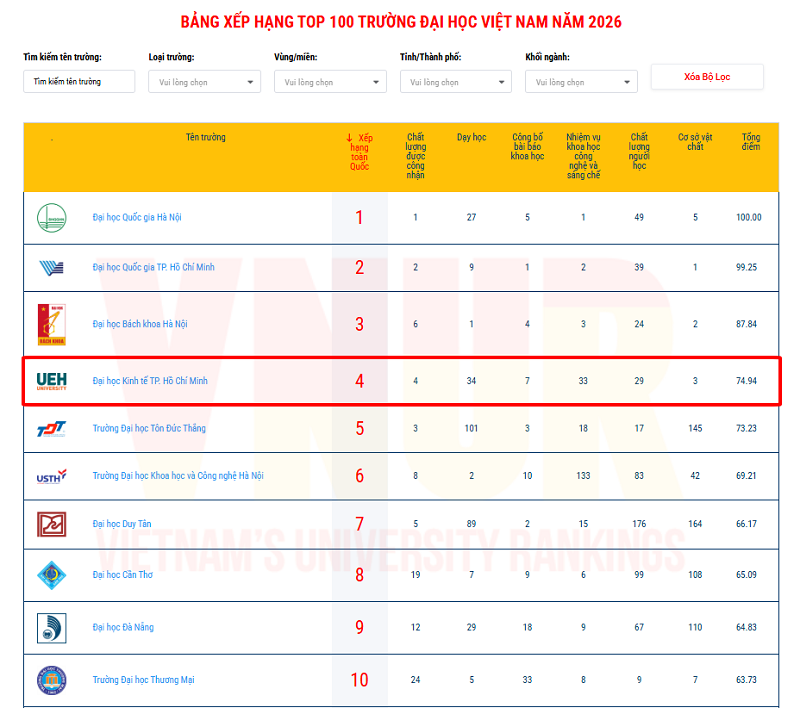
Top 10 Vietnamese Higher Education Institutions according to VNUR 2026 (Photo: VNUR)
According to the organizing board, VNUR 2026 reviewed 237 higher education institutions offering bachelor's degree programs or higher, of which 193 having sufficient public data to be included in the rankings. Data was collected from multiple independent sources, including annual reports, admissions schemes, the Ministry of Education and Training's accreditation system, international rankings (QS, THE, ARWU), and scientific databases (Scopus, Web of Science), data on inventions, scientific journals, digital libraries, and facilities. The ranking is based on 6 standards and 18 criteria, with a strong emphasis on Accredited Quality (30%) and Teaching (25%), reflecting a growing trend toward evaluating the tangible effectiveness of higher education.
Beyond reflecting academic standing, the criteria structure of VNUR 2026 shows a clear shift toward "evaluating graduate outcomes." The criteria for teaching, learner quality, and accredited recognition are all directly linked to the ability of graduates to meet labor market demands.
For UEH, maintaining its top 4 position for several consecutive years is not only a result of scientific publications or scientific-technological missions, but is also closely tied to its output-quality-centered training approach, which centers on enhancing experiential learning, enterprise connections, and benchmarks against international standards. This foundation is further "validated" by concrete employment indicators for its graduates.
The 2025 graduate internship and employment survey results, recently released by UEH, provide clear evidence of the tangible effectiveness of the training quality that VNUR has recognized. According to the survey, 97% of UEH graduates are employed within one year of graduation, with 90% working in their field of study or a related field.
Notably, 69% of students secured a job before receiving their degrees, 12% found employment within one month after graduation, and only about 2% took longer than six months to find a job. These figures demonstrate a rapid transition capability from the lecture hall to the labor market—a key indicator of training quality in a volatile job market.
Furthermore, 30% of UEH's 2025 graduates work for enterprises with foreign elements, reflecting the increasingly strong integration capabilities of its learners.
In terms of job quality, 72% of graduates earn over 9 million VND per month, and 78% are satisfied with their current job. Concurrently, 93.4% of students were satisfied with their learning experience and 95.6% were satisfied with the learning environment and culture at UEH, showing a strong link between a positive learning experience and post-graduation job quality.
Additionally, the 2025 enterprise survey revealed that 90% of companies rated UEH interns as 'Very Good' or 'Excellent,' and 98% were willing to hire UEH students after graduation. This is a testament to the effectiveness of the practice-oriented training model, including corporate semesters and project-based learning, that UEH has persistently implemented over the years.
In the context of the significant ranking shifts in VNUR 2026, UEH's maintenance of its 4th position nationwide, coupled with its very high post-graduation employment rate, demonstrates a sustainable approach to higher education development: the capacity to create career opportunities and long-term value for learners and society. This is also the foundation for UEH to continue realizing its strategy of becoming a multidisciplinary, sustainable university, tightly integrating training, research, and the labor market in its next phase of development.
News, photos: Department of Communications and Partnerships