
University of Economics Ho Chi Minh City: QS and THE in the Picture of University Governance
05 Feb, 2026


[Tuoi Tre Newspaper] - For the University of Economics Ho Chi Minh City (UEH), rankings such as QS and THE are no longer seen merely as ranking tables, but increasingly as a reference framework for modern university governance.

University of Economics Ho Chi Minh City: QS and THE in the picture of university governance - Photo: UEH
A reporter spoke with Assoc. Prof. Bui Quang Hung - Interim President of UEH - to clarify how UEH approaches QS and THE in its strategy to improve training quality, research, academic reputation, and international cooperation.
What is the current role of international rankings such as QS and THE?
Assoc. Prof. Bui Quang Hung: In the context of Vietnamese higher education shifting from broad expansion to quality enhancement, standards, and accountability, the University views international rankings such as QS and THE as guiding and reference tools for university governance, while ranking position itself is only a number, not the ultimate destination.
QS and THE help shift university evaluation from intuition to data-based quantitative measures, reflecting more clearly the actual capacity for teaching, research, and governance.
QS and THE also reflect quite comprehensively the core capabilities of an advanced university, focusing on four pillars: teaching quality, scientific research, internationalization, and connection with the labor market.
The regional separation (QS Asia and THE Asia) helps Vietnamese universities compare themselves within Asia - a space with development context and education system structures similar to Vietnam.
Although QS and THE use different measurement methods and weights, they share many criteria in essence, especially in teaching, research, internationalization, and enterprise cooperation. UEH does not approach each ranking separately, but focuses on the overlap between the criteria, considering that the common core for reviewing and comprehensively upgrading internal capabilities.
| QS Asia | THE Asia |
|
Academic Reputation (30%) Faculty/Student Ratio (10%) Staff with PhD (5%) |
Teaching (24.5%) Teaching reputation Staff-to-student ratio Doctorate-to-bachelor’s ratio Doctorates-awarded-to-academic-staff ratio Institutional income |
|
Papers per faculty (5%) Citations per paper (10%) |
Research Environment (28%) Research reputation Research income Research productivity Research Quality (30%) Citation impact Research strength Research excellence Research influence |
|
International Faculty (2.5%) International Students (2.5%) Inbound & Outbound Exchange Students (5%) International Research Network (10%) |
International Outlook (7.5%) Proportion of international staff Proportion of international students International collaboration |
| Employer Reputation (20%) |
Industry (10%) Industry income Patents |
Comparison of assessment criteria between QS Asia and THE Asia (Note: the criteria are kept in English to preserve meaning. Similar criteria are aligned horizontally.)
So how does UEH concretize QS and THE in upgrading training quality?
When benchmarked against the training standards of QS and THE, the University meets and exceeds 7 out of 10 criteria compared with domestic standards and is approaching the standards of the top 250 universities in Asia.
However, the benchmarking results also reveal clear challenges, especially regarding the faculty workforce. UEH is a key national university with a large training scale, while the number and structure of its lecturers still lag behind regional standards. As a result, UEH faces significant pressure in meeting criteria related to the student-to-faculty ratio and teaching-research capacity, especially in new and interdisciplinary fields.
These are the issues that QS and THE help the University identify clearly in order to continue adjusting its training development strategy in the next phase, particularly its multidisciplinary strategy, pioneering business and economics disciplines linked with technology and applied design.
How do QS and THE guide scientific research development?
These rankings assess research capacity through key criteria such as the quantity and quality of international publications, citation levels, research impact in the discipline, the quality of the research environment, and the academic reputation of lecturers and scientists.
Thanks to numerous policies promoting research-oriented university development, over the past five years UEH’s number of international publications has increased 4.7 times, with Q1–Q2 papers accounting for about 85%, showing a clear shift from quantity growth to quality enhancement.
Research quality has continued to improve through citation indicators, FWCI, and the proportion of articles in high CiteScore groups, reflecting the impact and spread of research outcomes within the international academic community.
However, when benchmarked against top Asian universities, the University still faces structural challenges. Research productivity per lecturer remains lower than regional standards; there are still not many leading scholars who can guide, orient, and create international academic influence; and the scale and effectiveness of strong research groups remain disproportionate to the University’s development ambition.
These are key criteria in QS and THE that the University must continue to invest in for the long term if it wants to maintain and improve its ranking position in the coming years.
How do QS and THE affect UEH’s brand reputation in the academic community and labor market?
QS and THE are considered a common language of the international academic community and labor market, reflecting the degree of external recognition and trust. In particular, criteria such as academic reputation and employer reputation are built on large-scale surveys of scholars and employers worldwide.
UEH has affirmed its position as a key and leading university in Vietnam; however, within the regional and international space, its academic reputation and brand recognition still need to be further enhanced. Therefore, in the coming period, the University will implement many policies to attract leading international scholars and researchers.
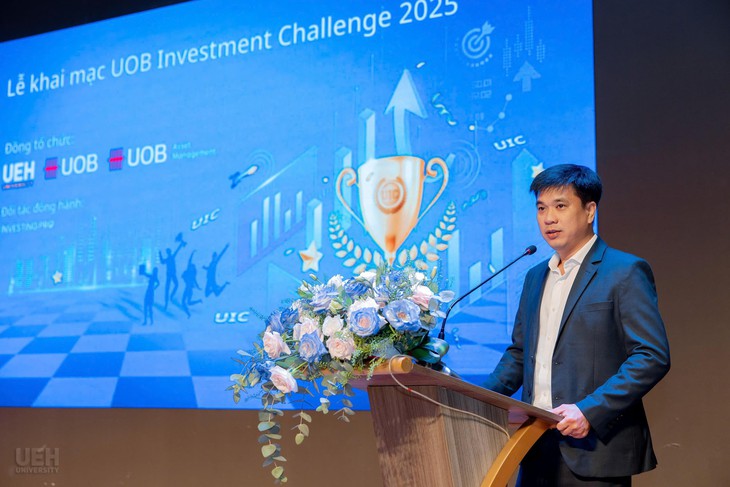
Assoc. Prof. Bui Quang Hung - Interim President of UEH - Photo: UEH
In international cooperation, how is the role of QS and THE rankings perceived?
Rankings cannot replace actual quality, but in international cooperation, ranking position is often the starting condition. When implementing articulation programs, dual-degree programs, or research collaboration, positions in QS and THE give leading universities worldwide an initial view of the University’s teaching, research, and governance capacity.
Currently, UEH is in the Top 301+ Best Universities in Asia in QS Asia 2026, Top 136 Best Universities in Asia in Times Higher Education 2025, and Top 501–600 Universities in the World in Times Higher Education 2025, 2026.
This is an important condition for UEH to establish win-win partnerships and maintain and improve its ranking position in line with its quality and international development orientation.
The number of universities participating in these rankings increases by about 20–30% each year. Therefore, maintaining one’s ranking is difficult, and moving up is even harder. As noted, ranking reflects long-term accumulated results, requiring synchronized improvement across teaching, research, and governance in a sustainable way.
Source: Tuoi Tre Newspaper