
UEH selected to participate in the specialized ai training initiative: Transforming technology into socio-economic value
21 Nov, 2026



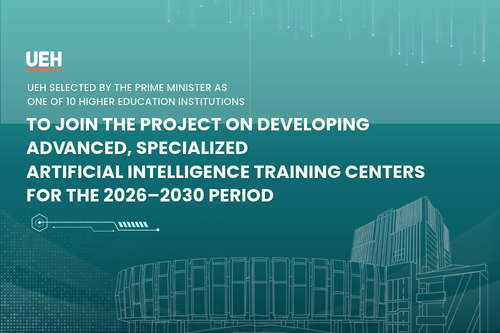
On November 8, 2026, Deputy Prime Minister Le Tien Chau signed Decision No. 2146/QD-TTg of the Prime Minister approving the Initiative for the Development of Selected Training Institutions into Advanced and Specialized Artificial Intelligence (AI) Training Centers for the 2026–2030 period. UEH is among the 10 institutions initially selected to participate, contributing to Vietnam’s network for AI training, research, development, application, and governance.
A Multidisciplinary Foundation Connecting Technology with Real-World Applications
The national initiative aims to develop centers under a hub-and-network model, with clearly defined roles, collaboration, and resource sharing. It links training, research, and technology transfer with the needs of the government, businesses, and society. Within this framework, UEH is well-positioned to contribute through its capacity to connect technology with various fields of application.
This capacity builds on UEH’s strengths in economics, business, and management, alongside its ongoing development of programs in technology, data, and AI. The integration of these disciplines, together with laboratory systems, creative spaces, and partner networks, enables UEH to approach AI challenges from multiple perspectives, including technical considerations, economic efficiency, implementation conditions, and social impact.
For an AI solution to create value, it must be integrated into an organization’s data, operational processes, and decision-making mechanisms. This requires a workforce that understands both technology and the specific fields in which it is applied, with the ability to evaluate effectiveness and manage risks. This is the area UEH focuses on developing as part of the network.
Under UEH’s AI development initiative, the University aims to serve as a bridge connecting foundational AI research groups with the practical challenges of businesses and the public sector. UEH is developing its technological capabilities while placing application, governance, and the transformation of AI into socio-economic value at the center of its distinctive approach. Research priorities include the capacity to adopt, integrate, and scale AI applications, as well as their impacts on productivity, employment, skills, and business models.
Developing AI Talent, Co-Creating Solutions, and Transferring AI Technologies
Through its participation in the initiative, UEH aims to continue reviewing its academic programs, learning outcomes, and AI-integrated curricula, while developing specialized, interdisciplinary, and application-oriented training tailored to different fields. The focus is on developing two complementary workforce groups: technology professionals who understand industry-specific challenges, and domain specialists capable of leveraging data and applying AI in their work.
Learners need to develop the competencies to identify problems, select appropriate methods, implement solutions, and validate results. Alongside professional knowledge, responsible AI use is integrated into the training process, with particular emphasis on data protection, reliability, and accountability.
In research and technology transfer, UEH proposes a two-way collaboration mechanism connecting technology research groups with businesses, local authorities, and the public sector. Partners will work together throughout the process, from defining challenges and preparing data to developing, testing, and evaluating solutions. Real-world needs will serve as inputs for research and training, while pilot results will be used to further refine technologies, assess implementation feasibility, and scale up successful solutions.
Under this approach, AI effectiveness will be evaluated through tangible improvements, such as reduced processing time, optimized costs, improved decision-making quality, increased productivity, and expanded access to services. At the same time, research will help identify the workforce, organizational, and governance conditions necessary for technology to deliver its full potential.
This implementation direction is aligned with UEH’s strategy of becoming a co-creating university and serving as an Urban Innovation Hub – UEH UniverCity Innovation Hub, connecting knowledge, technology, and partners to collaboratively address challenges faced by businesses, cities, and regions. Being selected to participate in the initiative provides further opportunities for UEH to strengthen its AI training, research, and collaboration infrastructure, contributing to the national network through high-quality human resources and solutions that generate measurable socio-economic value.
|
Five Years of Integrating Applied AI Knowledge into Strategy, Training, Research, and Technology Transfer
|
News and photos: Department of Communications and Partnerships