
UEH leads Vietnamese universities, enters Top 15 in Southeast Asia according to Times Higher Education Pilot Ranking
12 Mar, 2026

The University of Economics Ho Chi Minh City (UEH) has been ranked among the Top 15 universities in Southeast Asia in the Times Higher Education ranking announced on March 11, 2026. Among 104 ranked universities from 8 countries, UEH is the highest-ranked Vietnamese representative, further affirming the academic standing of Vietnamese higher education within the regional university ecosystem.
UEH's prominent position in the Southeast Asian higher education landscape
According to the ranking results, UEH entered the Top 15 in Southeast Asia and belongs to the 501–600 group globally under the Times Higher Education assessment system, alongside renowned regional universities such as Chulalongkorn University (12th) and Mahidol University (14th).
This result reflects UEH's relatively balanced development across multiple criteria, including: research quality, connectivity with the business ecosystem, and level of internationalization. Specifically, the research quality indicator reaches 92,1/100 points, demonstrating that UEH's scientific publications are highly cited and featured in top global impact journals.
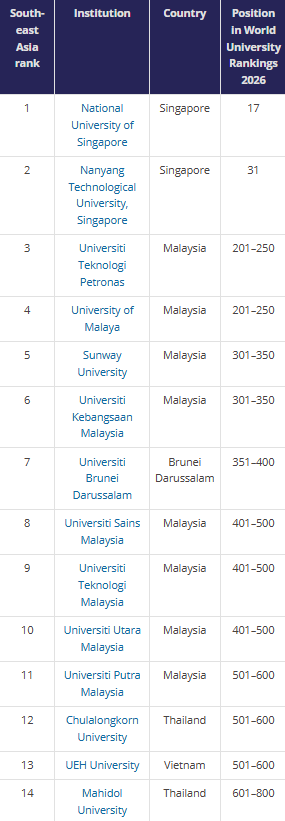
UEH leads Vietnamese universities, ranked 13th in Southeast Asia
Systematic ranking governance approach and achievements across multiple world university rankings
This achievement results from the university's methodical ranking governance strategy, which has been evidenced by UEH's positions across various world university rankings in recent years.
Currently, UEH belongs to Top 501-600 universities globally, Top 136 in Asia, Top 15 in Southeast Asia according to THE ranking system. The university also ranks in the Top 301-400 for contribution to the United Nations' 17 Sustainable Development Goals according to THE Impact Rankings 2025. In the QS rankings, UEH is assessed among the 301+ Best Universities in Asia.
Accordingly, UEH has developed a 7-step ranking governance process, including: (i) identifying priority rankings; (ii) benchmarking criteria against national and international standards; (iii) developing an internal indicator set; (iv) assessing university-wide; (v) setting objectives linked to the OKRs system; (vi) applying technology in ranking data governance; and (vii) conducting periodic evaluations to adjust action strategies.
Building on this foundation, UEH focuses on 04 key international rankings, including: QS, THE, QS Sustainability and THE Impact Rankings - assessment systems that comprehensively reflect the capabilities of a modern university, from training quality and scientific research to internationalization level and contributions to sustainable development.
A highlight of UEH's approach is the direct linkage of ranking indicators with the university's overall development strategy: "A Multidisciplinary, Innovative, and Sustainable University, contributing to local, national, and global development," built on 5 strategic pillars: Training, Research, Governance, Operations, and Community. This internal foundation enables UEH to progressively improve its academic standing sustainably.
In the context where higher education is increasingly competitive in research, innovation, and internationalization, global rankings are becoming important metrics reflecting universities' academic capabilities. International rankings therefore not only recognize UEH's development outcomes but also reflect the trend of elevating Vietnamese higher education standards on the international academic map.
Southeast Asia Pilot Ranking (THE)The Southeast Asia university ranking is constructed based on data from the Times Higher Education World University Rankings, but focuses specifically on countries within the Association of Southeast Asian Nations (ASEAN). This is considered a pilot ranking aimed at providing a more detailed perspective on higher education development in the region - one of the most dynamic and fastest-growing areas in the world. Universities are evaluated based on 18 indicators across 5 core criterion groups, including:
To be eligible for ranking, universities must have a minimum of 1,000 scientific publications in the last 5 years indexed in the Scopus database. According to Times Higher Education, in subsequent versions, this threshold may be adjusted to expand the number of participating institutions. *View the detailed ranking here [Link]. |
News, images: Department of Communications and Partnerships