
Steady advances in the 2025 education strategy: Developing human resources for a new phase of growth
15 Feb, 2026


In 2025, the University of Economics Ho Chi Minh City (UEH) reaffirmed its steady progress in developing high-quality human resources through a multidisciplinary and interdisciplinary training approach, integrating the digital economy and international integration. These efforts have contributed to strengthening the Education pillar in UEH’s overall development strategy.
Expanding multidisciplinary learning opportunities and raising entry quality standards at the undergraduate level
In 2025, UEH continued to reinforce its attractiveness and reputation, with 7,650 new students enrolling in full-time undergraduate programs through 05 diverse, transparent, and equitable admission methods, meeting the entry standards of the training programs.
In addition, in order to expand multidisciplinary knowledge and enhance practical experience for learners, the University implemented integrated double-degree and double-major programs such as:
- Agribusiness – International Business
- Agribusiness – Logistics and Supply Chain Management
- Insurance – Finance
- Public Management – Law & Local Governance
- Political Economy – Law & Local Governance
- Corporate Accounting – Taxation
- Business English – Tourism and Travel Services Management
- Communication Technology – International Business
- Communication Technology – Marketing
- Financial Mathematics – Banking

Double-major programs expand multidisciplinary learning opportunities
Moreover, domestic and international student exchange programs, as well as practical activities related to training content, were further strengthened. As a result, UEH developed 10 integrated double-major programs with the participation of 176 students, nearly doubling the figure compared to 2024.

Domestic and international student exchange programs
Diversifying postgraduate programs, enhancing quality and international integration capacity
UEH consistently creates the most favorable conditions for learners to fully develop their capabilities in learning and research activities. Accordingly, UEH graduates who achieve outstanding academic results within two years of graduation are admitted directly to master’s programs, thereby opening a new approach to postgraduate education and enabling the University to proactively identify and develop a high-quality pool of postgraduate students.

UEH continues to strengthen postgraduate admissions, creating enabling conditions for the development of high-quality research human resources
In parallel, UEH has accelerated digital transformation across the entire admissions, enrollment, and academic management processes on online platforms, contributing to improved learner experience, governance efficiency, and transparency. Postgraduate programs have continued to be renewed in line with international standards through the admission of 06 fully English-taught master’s programs and the further development of 03 Advanced Executive programs.
Furthermore, doctoral programs have increasingly focused on academic depth, with a professional research environment, effective mentoring mechanisms for doctoral candidates, and the establishment of core research groups led by reputable scholars from Viet Nam and abroad.
Alongside these innovation efforts, UEH’s admissions activities in 2025 recorded positive results, with total university-wide enrollment reaching 12,860 learners. This figure includes 7,650 full-time undergraduate students, 1,187 transfer students in full-time undergraduate programs, 586 second-degree undergraduate students, and 1,706 part-time learners. At the postgraduate level, UEH enrolled 1,578 master’s students and 153 doctoral candidates, underscoring its orientation toward developing high-quality research human resources.
Strengthening the integration of theory and practice through short-term training programs
Short-term training activities in 2025 expanded in scale, depth of expertise, and their degree of practical relevance. The program portfolio was broadened to closely align with emerging labour market demands and the public–private sectors, focusing on highly applied fields such as economic and financial management for the healthcare sector, digital transformation, e-commerce, logistics, procurement operations, as well as capacity-building programs for provincial-level officials, civil servants, and public employees, and specialized training programs commissioned by enterprises and large corporations.
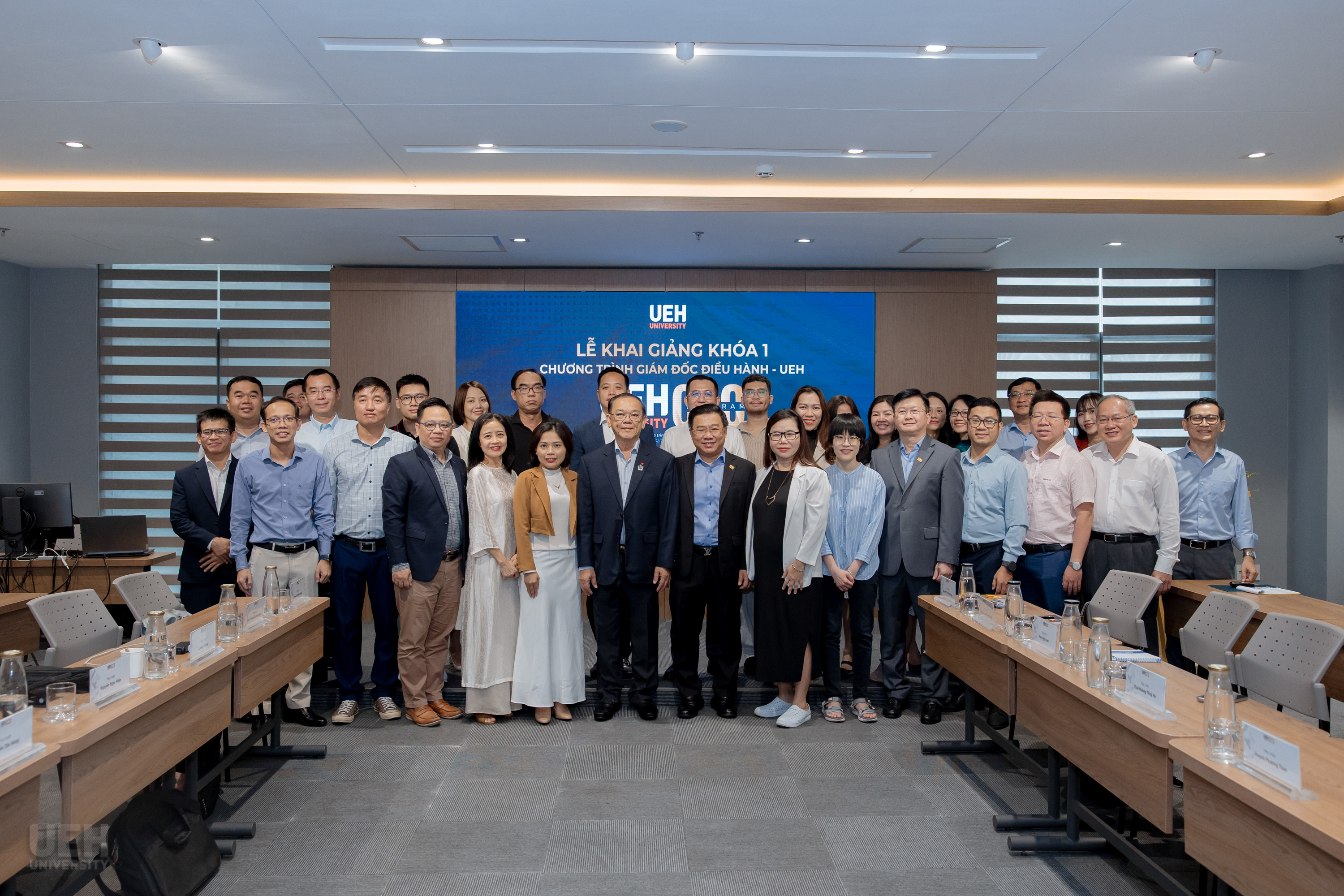
Cohort 1 of the UEH Chief Executive Officer - UEH (UEH CEO Program)
The effectiveness of implementation was clearly demonstrated by short-term training revenue exceeding the set targets and increasing by 27.21% compared to 2024, demonstrating UEH’s academic credibility as well as the University’s role in accompanying society and businesses in developing high-quality human resources.
The year 2025 marked a transition in UEH’s training activities, from ensuring scale and quality to building a flexible, multidisciplinary, and globally adaptive training ecosystem that meets the needs of learners, the labour market, and future workforce development. On the foundation of digital governance and a sustainability-oriented approach, the Training pillar continues to play a central role in UEH’s strategy to develop into a multidisciplinary, research-oriented, and internationally integrated university, creating long-term value for learners and society./.
Pillars: Training, Community
Project: UEH Connecting
News, photo: Department of Quality Assurance and Internal Control