Scientific Workshop: The Impact of Fiscal Decentralization on Energy Poverty among Vietnamese Households
17 Mar, 2026

On March 12, 2026, a scientific workshop themed "The Impact of Fiscal Decentralization on Energy Poverty among Vietnamese Households" was held at Campus B – University of Economics Ho Chi Minh City (UEH), attracting keen interest and lively discussion from lecturers and students both within and outside UEH.
.jpg)
Overview of the workshop
The workshop was conducted within the framework of a Ministry-level research project (Code: B2025-KSA-02), led by Dr. Doan Vu Nguyen, with team members including Dr. Nguyen Phuc Canh, Prof. Dr. Su Dinh Thanh, MSc. Nguyen Quang Binh, and MSc. Tran Le Thuy Duyen. At the workshop, Dr. Nguyen Phuc Canh and Dr. Doan Vu Nguyen presented the key research findings in turn, under the chairmanship of Dr. Tran Thi Tuan Anh – Vice Rector of UEH College of Economics, Law and Government.
Opening the workshop, Dr. Nguyen Phuc Canh contextualized the research by highlighting that energy is one of the 17 United Nations Sustainable Development Goals (SDG 7). Drawing on data from UNDP (2007) alongside previous studies in Vietnam and internationally, he demonstrated that energy poverty is a multidimensional concept and that considerable debate persists regarding its measurement approaches. Furthermore, while the government is regarded as a key actor in addressing this issue, research on the relationship between fiscal decentralization and energy poverty remains limited. This underscores the necessity of investigating multidimensional energy poverty measurement, as well as the role of fiscal decentralization at the provincial and municipal levels in shaping the energy poverty landscape in Vietnam.
.jpg)
Presentation by Dr. Nguyen Phuc Canh
Continuing the discussion, Dr. Doan Vu Nguyen emphasized the novelty of the research, which lies in measuring energy poverty in Vietnam through a Multidimensional Energy Poverty Index (MEPI) approach based on Vietnam Household Living Standards Survey (VHLSS) data for the 2004–2020 period. This index is constructed from four component indicators: TPR – the electricity expenditure burden (exceeding 10% of living costs); LIHC – low income combined with high energy costs; M2 – low electricity consumption (below 50% of the national median); and MOT – limited access to modern electrical appliances. Using the Coefficient of Variation (CV), the study measured the degree of inequality across population groups and arrived at two principal findings. First, energy poverty is prevalent among vulnerable population groups, concentrated in underdeveloped areas, with significant inequality observed across household categories. Second, fiscal decentralization correlates with a declining trend in energy poverty. Based on these findings, the research team also offered a number of carefully considered policy recommendations aimed at improving energy poverty conditions in Vietnam.
.jpg)
Presentation by Dr. Doan Vu Nguyen
.jpg)
Dr. Tran Thi Tuan Anh moderating the discussion session
Under the moderation of Dr. Tran Thi Tuan Anh, the discussion session unfolded dynamically, with numerous contributions from attending delegates. The exchanges not only helped refine the research project but also opened up further research directions related to the theme of energy poverty in the coming period.
Through this workshop, UEH continues to affirm its role as an academic environment that promotes research closely linked to contemporary socio-economic issues, while also providing a forum connecting researchers, lecturers, and students to exchange ideas and propose policy implications oriented toward sustainable development in Vietnam.
.jpg)
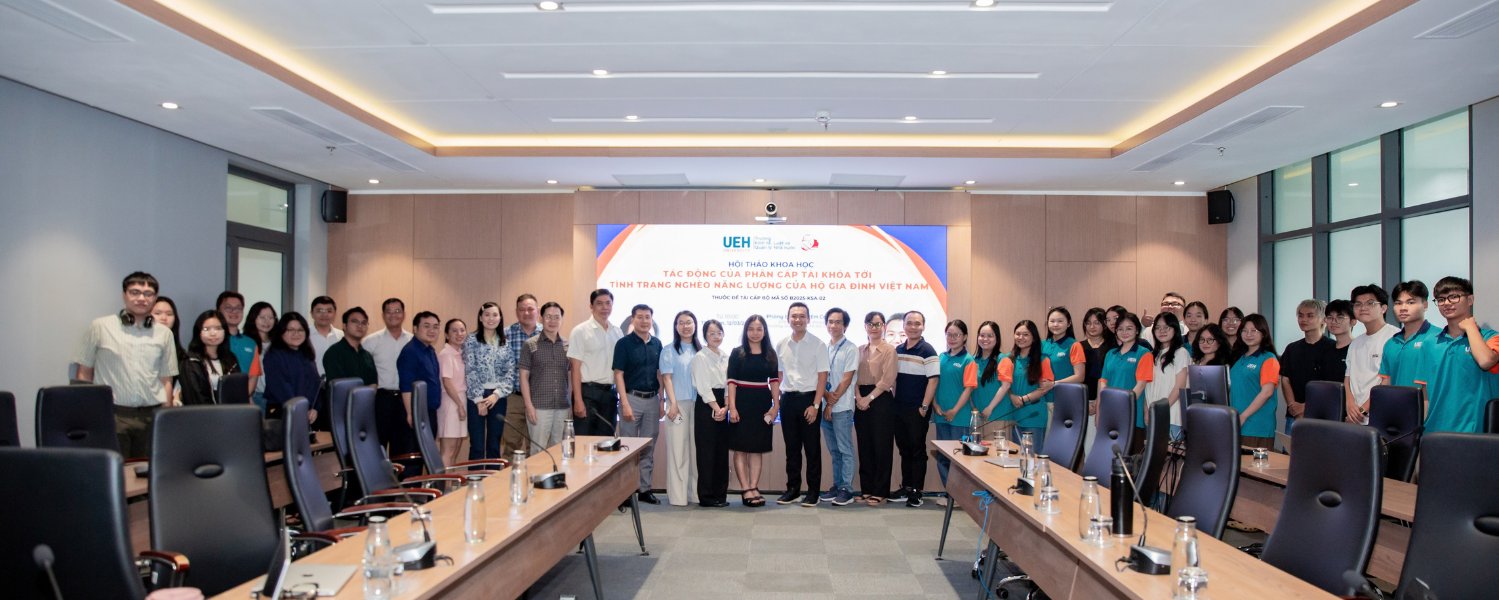
Commemorative group photo at the workshop
Pillars: Research, Community
News and Images: Research Team, Department of Communications and Partnerships