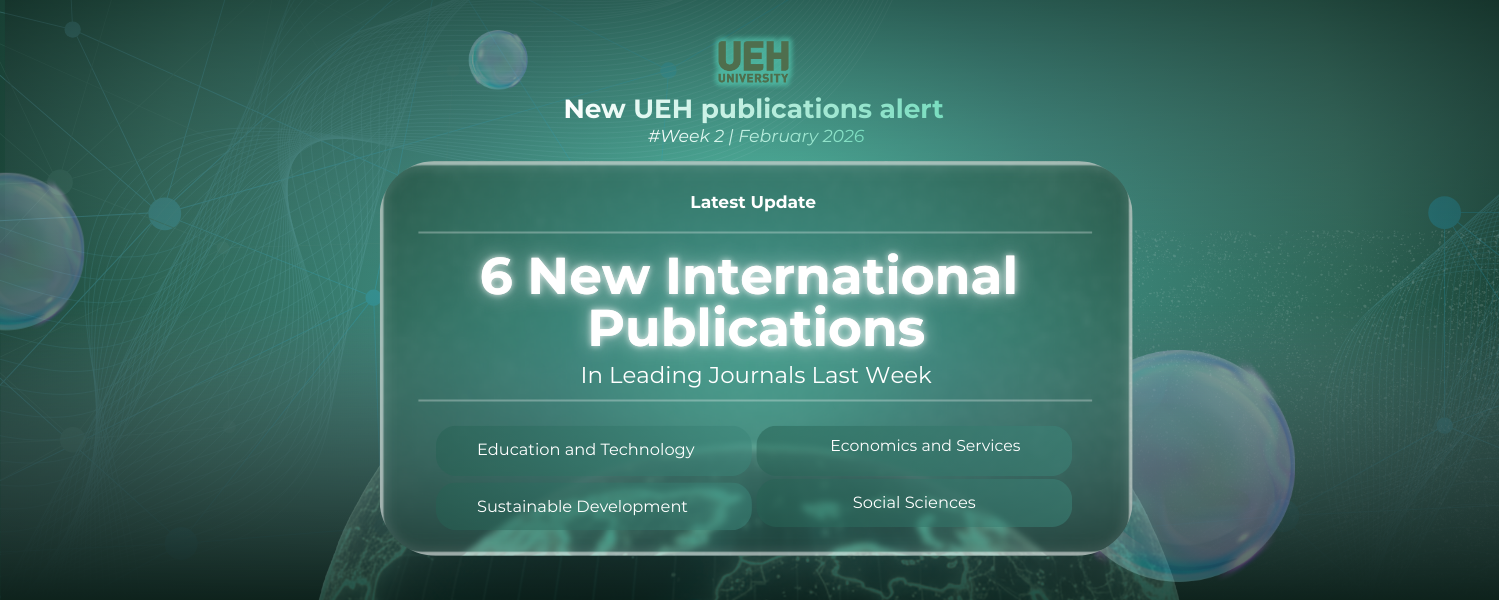
New UEH Publications Alert (Issue 2 - February 2026): UEH Records 6 New International Publications - Interdisciplinary Approach, Technology Integration, and Sustainable Development
09 Feb, 2026


This past week, the scientific research activities at the University of Economics Ho Chi Minh City (UEH) continued to show strong momentum, with 06 new works published in prestigious journals listed in Web of Science (Q1-Q2), Scopus, and ABDC (A-ranked). These studies not only affirm UEH's international-standard academic capacity but also clearly demonstrate its multidisciplinary orientation in addressing contemporary socio-economic challenges.
Enriching Global Knowledge from Vietnam's Practical Context
A key highlight of this week's publications is a shift from merely applying to actively expanding foundational theoretical frameworks. UEH authors have skillfully integrated emerging elements of the digital age - such as Artificial Intelligence (AI), Gamification, Digital Transformation, and Carbon Communication - into traditional research models.
Using modern approaches and advanced analytical methods (SEM, PLS-SEM, mixed quantitative-qualitative designs) on large-scale datasets, these studies have provided valuable empirical evidence from the perspective of a developing economy, thereby contributing to the diversity of the global scientific body of knowledge.
Diversified fields: From Digital finance to Applied linguistics
The scope of research this past week was broad, reflecting the University's strong interdisciplinary nature:
+ Education and Technology: Proposing learning designs that integrate AI and Gamification, opening new directions for higher education in the digital era.
+ Economics and Services: Providing in-depth analysis of consumer behavior, banking services, and digital finance (Fintech), offering a basis for strategies to enhance the customer experience.
+ Sustainable Development: Focusing on sustainable tourism, green marketing, and environmental communication, closely linking economic benefits with social responsibility.
+ Social Sciences: Expanding into applied linguistics and behavioral psychology, clarifying mechanisms for complaint resolution and improving employee well-being.
Creating value for the community and policy
Going beyond theory, the research findings offer practical policy and governance implications for a wide range of stakeholders, from education policymakers and fintech business leaders to service and tourism organizations.
Through these publications, UEH is progressively affirming its position as an interdisciplinary research center with strong academic capabilities, committed to creating knowledge with widespread impact and contributing positively to the sustainable development goals of Vietnam and the region.
This week's publication list
Authors: Loc Tan Nguyen & Jessie Barrot
Journal: Computer Assisted Language Learning (WOS SSCI Q1)
Summary: Despite the growing potential of computer-assisted pronunciation training (CAPT) tools, time constraints in classroom instruction continue to limit opportunities for individualized pronunciation practice. Technology offers a flexible means to extend learning beyond class time.
Authors: Bang Nguyen-Viet and Yen Thi Hoang Nguyen
Journal: Asia Pacific Business Review, WOS (SSCI Q3)
Summary: Despite their widespread adoption as digital payment tools, mobile wallets often face challenges in maintaining user engagement, particularly in contexts where initial adoption is driven by unavoidable circumstances rather than user preference.
Authors: Huu Nghia Le, Tu Anh Nguyen, Mai Thao Nguyen Le, Huynh Ha Co Le, Le Phuong Quynh Nguyen & Thi Phuong Ngoc Vo
Journal: Tourism Recreation Research, ABDC (A)
Summary: This study investigates how Generation Z tourists form support for carbon-surcharge communication in tourism, using Vietnam as an emerging-economy case. A sequential explanatory mixed-methods design combined quantitative modelling (n = 255) with qualitative interviews (n = 32).
Authors: Bang Nguyen-Viet and Phuc My Nguyen
Journal: International Journal of Productivity and Performance Management, Scopus Q1
Summary: This study explores the antecedents and impacts of customer incivility (CI) on frontline employees (FLEs) in Vietnam’s banking sector and eco-friendly hotel industry with religious beliefs (RB) and internal green marketing orientation (IGMO) as moderators
Authors: Bang Nguyen-Viet, Hương Doan
Journal: Asian Education and Development Studies, Scopus Q1
Summary: This research adoptsthe framework ofself-determination theory (SDT) to explore how gamification and artificial intelligence (AI) impact students’ learning effectiveness by addressing their fundamental psychological needs (competence, autonomy and relatedness) and fostering intrinsic motivation. Specifically, the study aims to (1) examine how gamification and AI respectively influence these basic psychological needs, (2) analyze how the satisfaction of these needs affectsintrinsic motivation and (3) investigate the mediating role of intrinsic motivation in enhancing students’ learning effectiveness
Authors: Nguyen Le, Thi Bich Ngoc Mai, Thi Bach Hop Phan, Thanh Truc Le & Thi Lien Hoa Nguyen
Journal: Journal of Ecotourism, Scopus Q1
Summary: In the blooming landscape of virtual environments and phygital marketing, 360-degree virtual reality (VR) video has appeared as a powerful tool in ecotourism, allowing traveller to explore attractions in an authentic and immersive way. On the basis of in the Stimulus-Organism-Response (SOR) framework, this study aims to clarify the effects of 360-degree VR videos (Stimulus) on immersion and enjoyment (Organism), with expectations of the destination’s uniqueness, ultimately influencing tourists’ intentions to visit ecotourism spots (Response).
Pillar: Research
News & Photos: Department of Research - Development and Global Engagement), Department of Communications and Partnerships