CELG Academic Seminar No. 03/2026: When open-source becomes a sustainable academic choice
03 Jun, 2026
On May 28, 2026, the UEH School of Economics, Law and Government (CELG) held its third periodic academic seminar of 2026, themed "The Open-Source Ecosystem in Data Analysis and Scientific Research." The session drew more than 50 faculty members, doctoral candidates, and students, who gathered to discuss tools that are increasingly important in teaching, research, and academic practice.
In her opening remarks, Dr. Tran Thi Tuan Anh, Vice Rector of CELG, highlighted the significance of the seminar series as an open space for lecturers, doctoral candidates, and researchers to share experiences, update their knowledge, and nurture a spirit of interdisciplinary inquiry. She noted that such gatherings not only broaden professional perspectives but also help build a more cohesive and sustainable research community.

Dr. Tran Thi Tuan Anh, Vice Rector of CELG, delivering opening remarks
In their presentations, Dr. Pham Thai Binh (Sustainable Finance Institute) and Dr. Doan Vu Nguyen (School of Public Finance) introduced a range of open-source tools widely used in data analysis and scientific research. Drawing on their practical experience in teaching and research, both speakers demonstrated that open-source solutions are not merely an alternative but an approach that empowers learners and researchers to take greater ownership of their tools, data, and analytical processes.

Dr. Pham Thai Binh introducing accessible and user-friendly open-source tools
Dr. Pham Thai Binh presented tools including JASP, ADANCO, and Gretl, describing them as user-friendly platforms suited to a wide range of analytical needs, from applied statistics and basic econometrics to time-series and panel data, as well as structural models. A notable point he raised was that these tools allow users to focus more on analytical thinking and interpretation of results, rather than being hindered by technical barriers or licensing costs.
Continuing the program, Dr. Doan Vu Nguyen shared insights on the applications of R/RStudio and QGIS in econometric research and spatial data analysis. Drawing on personal experience, he emphasized that open-source tools have advanced considerably and can now support a wide range of complex research problems, while also helping users develop independent, flexible, and highly reproducible ways of working.

Dr. Doan Vu Nguyen presenting on the application of tools in econometric research
Beyond their professional value, the presentations also raised a broader point relevant to today's academic environment: the choice of research tools is not merely a matter of cost but is also tied to transparency, legality, and academic integrity. As concerns around licensing, scholarly publication, and reproducibility continue to grow, the adoption of open-source platforms is emerging as a noteworthy trend, particularly for lecturers, doctoral candidates, and students.

Faculty members joining the discussion with the speakers
The discussion session was lively, with a range of contributions from faculty and attendees. Practical questions about how to select software, how to apply it in teaching, and how to integrate open-source tools into research all reflected the growing interest of the academic community in this area.

Dr. Tran Thi Tuan Anh - Vice Rector of CELG, and Dr. Nguyen Kim Quyen, Vice Dean of the School of Public Finance, presenting gifts of appreciation to the two speakers
Closing the seminar, Dr. Tran Thi Tuan Anh emphasized that the strength of a research community lies not only in individual capability but in the capacity to learn and grow together. This is the spirit that CELG seeks to cultivate through its regular academic activities: creating space for knowledge to be shared, experience to be passed on, and new ideas to take shape.

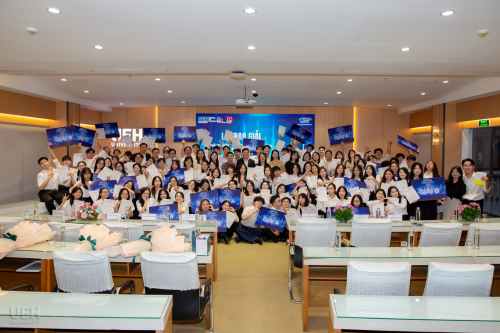
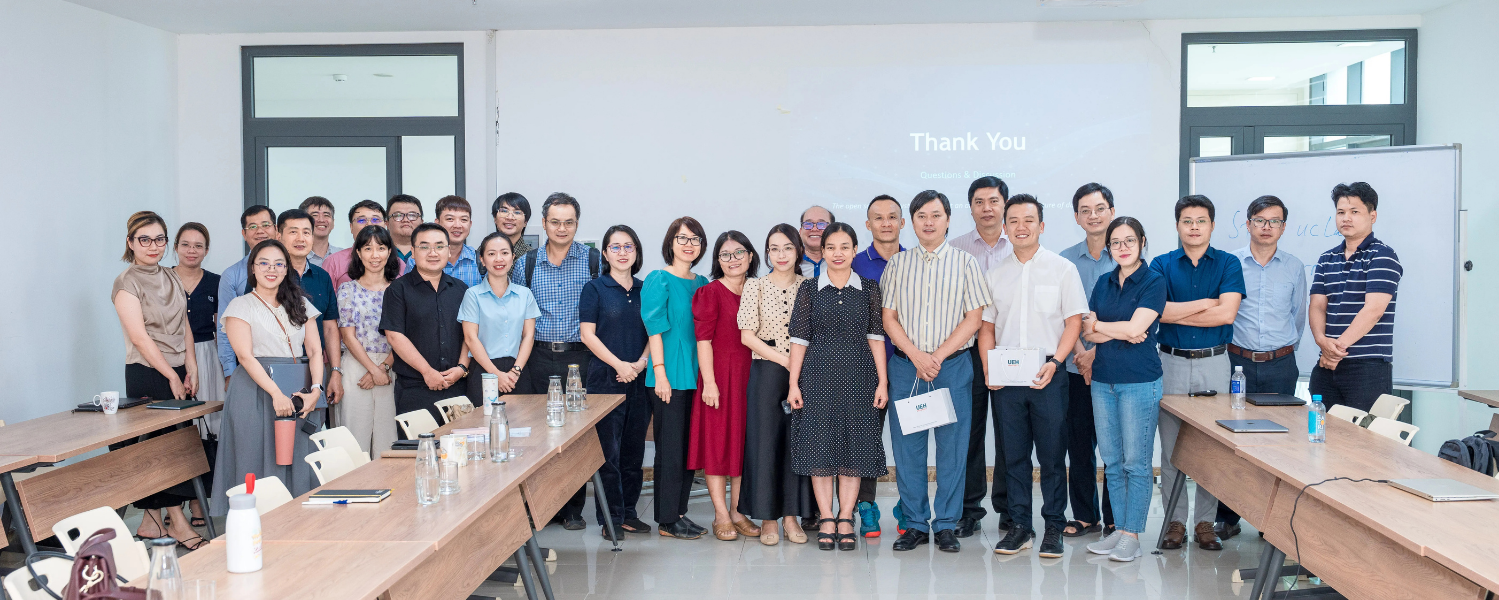
Faculty members in a group photo following the session
This seminar offered practical insights into the open-source ecosystem for data analysis and scientific research, while also inspiring a spirit of proactive learning, tool ownership, and research capacity development among lecturers, doctoral candidates, and students. From these thoughtful and substantive exchanges, it is clear that the academic journey becomes more sustainable when accompanied by open knowledge, a collaborative spirit, and a community united in the pursuit of shared growth.
News, photos: CELG Office