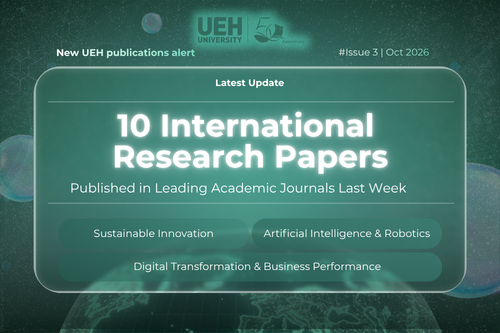
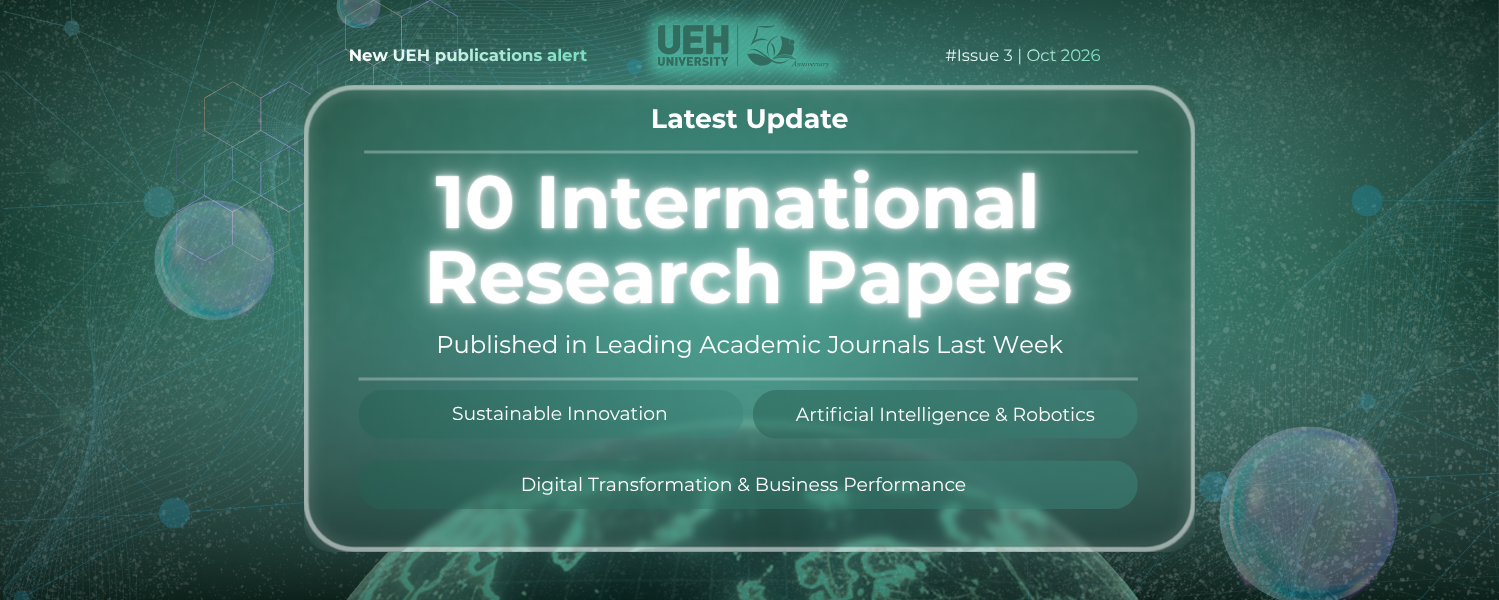
New UEH Publications Alert (Week 3 – October 2026): From Theoretical Frameworks to Robotics Systems and Human-Centered Technology
21 Oct, 2026


Robotics and Artificial Intelligence: From Architectural Spaces to Healthcare
One of this week's highlights is research on the development of robotic systems and intelligent algorithms aimed at addressing specific challenges in real-world environments and improving quality of life.
- - Addressing indoor localization challenges: Research on Indoor Visual Place Recognition focuses on the challenges of localization in buildings with repetitive architectural designs, where floors and corridors may share similar visual features. By combining visual information with textual data describing the scene, the TiP-MCE method leverages multimodal interactions to improve location discrimination, supporting robot localization and navigation in complex spaces.
- - Museum guide robots: Moving from localization challenges to practical applications, research on museum guide robots integrates mechanical design, control, and path planning to enable autonomous indoor operation. Equipped with a compact differential-drive platform, the system is designed to operate reliably and facilitate interaction in exhibition corridors with limited space.
- CareFeeder - an assistive feeding robot: The application of assistive robotics is further demonstrated through a low-cost feeding assistance system designed for older adults and people with Parkinson's disease. CareFeeder combines a three-compartment rotating tray, a three-degree-of-freedom robotic arm, an RGB camera, and a Raspberry Pi controller, together with a computer vision module for food recognition. The solution aims to promote greater independence during meals while emphasizing compact design, deployability, and cost-effectiveness.
Redefining Digital Transformation and AI Sustainability
Research on digital transformation shows that technology adoption alone is insufficient to ensure sustainable development outcomes. The value of technology also depends on organizational capabilities, governance mechanisms, and the ability to sustain its use over the long term.
- - Information and communication technology adoption and corporate sustainable development: Drawing on the Technology–Organization–Environment (TOE) framework, this study analyzes how the adoption of information and communication technology (ICT) promotes sustainable development through digital transformation. It also examines the moderating role of IT governance, risk management, and compliance (ITGRC), highlighting the importance of governance capabilities in translating technology investments into tangible outcomes.
- - Sustaining AI chatbot use in higher education: Rather than focusing solely on initial technology acceptance, this study integrates the Expectation Confirmation Model (ECM) with Knowledge Management (KM) factors to analyze the sustained use of AI chatbots in higher education. This approach seeks to identify the conditions that encourage learners and users to continue using chatbots for learning and administrative activities, thereby broadening perspectives on technology governance in educational settings.
Open Innovation and Core Competitiveness
At the organizational strategy level, research continues to clarify how businesses leverage external knowledge, restructure resources, and build competitive advantages in a volatile business environment.
- - Innovation ecosystem networks and sustainable business model innovation: Drawing on Absorptive Capacity Theory, this study analyzes the relationships among innovation ecosystem networks, inbound and outbound open innovation, and sustainable business model innovation. Absorptive capacity is examined as an important moderating factor, helping explain how businesses transform access to knowledge into innovation capabilities.
- - Innovation networks and sustainable performance: A related line of research examines the mediating role of open innovation in the relationship between innovation ecosystem networks and sustainable performance. The findings broaden understanding of how collaborative relationships and knowledge exchange can help businesses improve their long-term performance.
- - Market orientation and telecommunications firm performance: Combining the Resource-Based View (RBV) with Dynamic Capabilities Theory, this study analyzes the roles of market orientation and innovation capabilities in the performance of telecommunications firms in emerging economies. It emphasizes the importance of developing appropriate organizational capabilities to maintain competitive advantages in a changing environment.
Social Transformation and Global Resilience
In addition to technology and corporate governance, research on society, culture, and supply chains broadens UEH's academic landscape, reflecting changes in lifestyles, business environments, and the structure of the global economy.
- - Digital nomadism and cultural identity negotiation: Research on digital nomadism analyzes how remote workers combine location flexibility with cross-border mobility. It focuses on adapting to diverse cultural environments, maintaining personal identity, and positioning oneself within global stratification structures. This study broadens perspectives on the cultural and social impacts of flexible working trends in the post-pandemic era.
- - Logistics resource allocation and export cost efficiency: Research on garment export enterprises in Vietnam examines how logistics resource allocation and operational flexibility affect logistics cost efficiency, while analyzing the moderating role of environmental dynamism. The findings offer insights into the need for adaptive logistics management as businesses face market volatility and competitive pressures.
Overall, publications in Week 3 of October 2026 demonstrate the parallel development of theory-driven research that explains governance and competition mechanisms and technology-oriented research that advances robotic systems, computer vision, and human-assistance solutions. The integration of these two approaches reinforces UEH's multidisciplinary research orientation, bringing knowledge from academic foundations to meaningful applications for businesses and communities.
List of Publications This Week
For ease of reference and citation in international journals, the article titles in the list below are retained in English.
- Cultural adaptation and identity negotiation in digital nomadism: strategies, hybridization, and global stratification
Authors: The-Bao Luong, Thi-Thao Nguyen, Thai-Thinh Dang
Journal: Information Technology & Tourism, WOS (SSCI Q1) - Experimental Evaluation of a Service Robot for Museum Guidance: Mechanical Design, Path Planning, and Control
Authors: Thi Hoang Nhi Vu, Tri Cuong Do, Tri Dung Dang
Journal: Journal of Robotics, Scopus Q2 - TiP-MCE: Multimodal Cross-encoder Re-ranking for Indoor Visual Place Recognition
Authors: Tuyet Hue Tran, Thien Bao Nguyen, Khac Toan Nguyen
Journal: International Journal of Intelligent Engineering and Systems, Scopus Q2 - ICT Adoption and Corporate Sustainable Development: The Moderating Role of ITGRC
Authors: Thanh Tuan Nguyen, Dang Khoa Tran
Journal: Journal of Human, Earth, and Future, Scopus Q1 - A Hybrid ECM–KM Model for Predicting Sustainable Use of AI-based Chatbots in Higher Education
Authors: Ngoc-Hong Duong, Hong Anh Vo Thi, Kim Hue Phan Thi, Truc Quynh Tran Thi
Journal: International Journal of Information and Education Technology, Scopus Q2 - Vision-Based Food Detection Module for a Developed Assistive Eating Robot
Authors: Tri Cuong Do, Tri Dung Dang
Journal: Journal of Robotics, Scopus Q2 - Open Practices in the Innovation Ecological Network and Sustainable Business Model Innovation: The Moderating Role of Absorptive Capacity
Authors: Nguyen Thi Thuy, Tran Nha Ghi, Nguyen Tan Trung
Journal: Management Systems in Production Engineering, Scopus Q2 - Innovation Ecological Networks and Sustainable Performance: The Mediating Role of Open Innovation
Authors: Thuy, Nguyen Thi; Ghi, Tran Nha; Trung, Nguyen Tan
Journal: Journal of Human, Earth, and Future, Scopus Q1 - Market Orientation, Innovation, And Telecommunication Firm’s Performance In An Emerging Market: The Strategic Nexus Of Sustainable Competitive Advantage
Authors: Dai Trang Nguyen Thi, Candra Chahyadi
Journal: International Journal of Business and Society, Scopus Q3 - Strategic logistics resource allocation and flexibility for the logistics cost efficiency of garment export enterprises in Vietnam: the moderating role of environmental dynamism
Authors: Dung Tien Nguyen, Huong Xuan Ho (UEH), Dang Dinh Dao
Journal: Operations Management Research, WOS (SSCI Q1)
View the Week 3 – October 2026 publication list at:
https://news.ueh.edu.vn/2026/scientist/W3Oct.html
Explore the complete 2026 New UEH Publications Alert series at:
https://news.ueh.edu.vn/en/scientist
The New UEH Publications Alert series will continue to provide weekly updates on UEH's latest international publications. Faculty members, alumni, and learners are invited to follow the series and join UEH in spreading the spirit of “Research Contribution for All.”
Pillar: Research
News and photos: Department of Research, Development & Global Engagement; Department of Communications and Partnerships